Blog #5

The thing I will remember the most from this summer is the people. I do not mean to perpetuate a cliché, but it is true. Last semester was my first introduction to working in an office setting in my field. I have had jobs before, but never in an office setting. However, even in my past jobs I was always told I was too serious and needed to relax more. This was certainly true last semester. I did not really communicate much with people on the other teams. People probably thought I was introverted, which is not the case. This stems from the outlook I use to have that I must separate work and fun. I believed being serious was for work and having fun was for anytime else. However, I learned the hard way that not having any pleasure will make work seem long. This did in fact make the days worse. However, this semester has been drastically different.  Every day I come in, Joshua says good morning and it is a great start to the day. The new interns this semester across all teams have really just been a breath of fresh air with teaching me how to enjoy and laugh while at work. This even translates into the environment I want to create next semester. I want the apprentices on my team to enjoy coming to work every day, rather than dread it and wait for the day to be over. Again, this semester has encompassed a lot of transformational change for me personally.
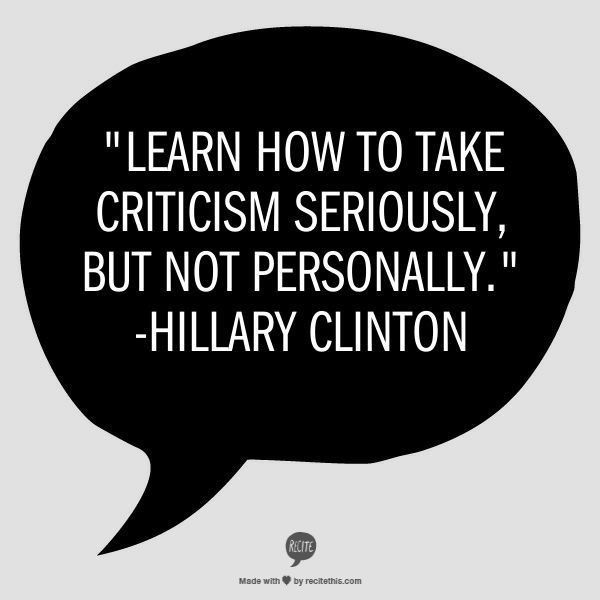
It is so surreal to think there is only three weeks left in the semester and this is the last post. This semester I have grown tremendously. As I have mentioned before, I was at the Children’s Campaign last semester as well. However, this semester has been different in so many ways. A new policy intern, a new resident, many new faces on the technology and communication teams, and even the leaving of Cal (who was by far my favorite full-time employee). This semester has required me to step up and change tremendously. First off, it has allowed me to take criticism. In my evaluations last semester, I was told that I don’t take criticism well and always try to explain myself. In part, this was due to what I felt was just me explaining my perspective on situations since my manager explained hers. Also, it was partly due to my perfectionism. It was great I learned that setting unrealistic expectations is not feasible and that I will not be able to do that with the new interns next semester. However, this semester I learned that critical feedback is not a personal attack on someone, rather someone’s perspective on things that could be improved or changed.

This semester has also showed me my capabilities. While some might say that I am doing too much at once, it has illuminated my limits. This internship is a 15 hour a week commitment, I also am taking 12 credits, I work on campus as a conference assistant with some weeks working 35 hours and others 15, and I am studying for the GRE. I am mentally tired at the end of each day, but it has shown me that even if I work full time in the future, I would easily be able to handle graduate school part time.

The two main projects the policy team has worked on this semester is researching privacy laws and the legislative agenda. With respect to the privacy laws, the team concluded any effort to restrict photography of minors in public spaces would result in roadblocks legislatively and judicially. In addition, the Legislative Agenda is the organization’s priorities on what we would like addressed in the next session. We have been researching and collecting data for each topic, and are now in the process of editing the document to reflect a briefer summary that is easier to comprehend by lawmakers and the general public.  Below I am attaching the two main projects the policy team has collaborated on. I have watermarked it as confidential because these documents are here for the sole purpose to inform the reader the work we are doing, and is not for distribution.

Even though this is the last blog post, these next three weeks will be just as impactful. I have learned so much and I am excited to see it through!

Blog Post #4

Joseph Rost taught us that leadership “is an influence relationship among leaders and followers who intend real change that reflects their mutual purposes” according to the postindustrial definition (Rost, 1993). He also states that leaders and followers develop mutual purposes. This helps every member feel included and increases buy in. This is accomplished mostly through the influence a leader has on the followers by persuasion (Rost, 1993). However, relationships that relies too much on persuasion can easily become coercive, which will eventually erode any mutual purposes and become unidirectional rather than multidirectional relationships between the leaders and followers. With respect to developing mutual purpose, it will be my job as the Resident Apprentice in the fall to make sure all team members feel their work is impactful and they are contributing to the mission of the nonprofit, rather than just busy work.

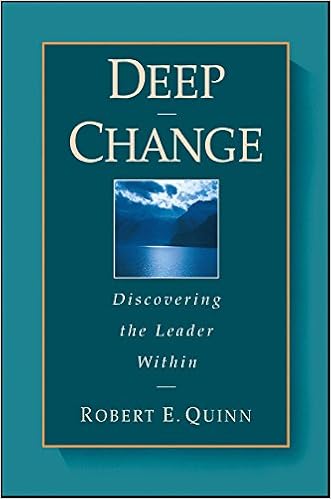
These next couple months until fall, I will be actively planning how I want this policy team structured and organized. I will be planning different ways to build community and increase trust between everyone. However, as Quinn notes, often much change will be accomplished when one “builds the bridge as you walk” (Quinn, 1996, p. 84). He even mentions that the path is often filled with uncertainty and no structure. This leads to a constant state of learning and new information allows us to make more informed choices. This will be certainly true in the case of group dynamics. Much of that will appear as each team member is able to interact with each other and I am able to observe them. I must wait to assess everyone’s strengths and weaknesses to better adapt at delegating tasks to everyone based on interests and skills.

Image result for deep change by quinn

In this role, I need to ensure that I do not become a manager that just delegates tasks. A true leader according Quinn, is a motivator who “emphasizes company values, challenges people with new goals and aspirations, and creates a sense of excitement” (Quinn, 1996, p. 149). As a leader, I need to ensure no one is dreading coming into work every day as people did last semester with the old resident. Committing 15 hours a week unpaid, for two semesters is a huge commitment alone. Additionally, dreading coming in to work will not only take a mental toll, but also will reduce one’s output and quality of their work as well.  That is why my position is so important to make sure no one is struggling and that people are able to feel successful and prepared in their roles.

Image result for common goals

As I prepare for this resident role next semester, I will continue observing how the residents from each team interact with their teams. I will continue to examine things that work and areas that can be done differently. This course has been a great way to examine the ways others and myself exhibit leadership at the experience site and has been a great way to reflect on different behaviors. I will also continue reflecting on all these things, with the intention now that I will need to build community in the fall between a handful of other people.

Quinn, R. E. (1996). Deep change: Discovering the leader within. San Francisco, CA: Jossey-Bass.

Rost, J. C. (1993). Leadership for the twenty-first century. New York: Praeger.

Blog Post #3

Image result for The Student Leadership Challenge: Five Practices for Becoming an Exemplary Leader.

Everyone has the capacity to lead, whether or not they are in a formal leadership role. This was truly seen at the end of last week where Eli, an intern on the technology team, was able to come out of his shell and facilitate the internship meeting. We both lead the meeting, but he was the star. He asked for guidance and he ran with it. I acted sort of as a mentor. In this case, I helped “transform goals into action” (Kouzes & Posner, 2014). I helped give him the confidence he always had to lead a meeting. This even was accomplished due to the collaboration and trust built between us. This relates to the second practice of exemplary leaders: enable others to act.

Reflecting on the resident from this semester and last semester is like night and day. The resident last semester was ineffective as a leader of our group because they did not “inspire a shared vision” by appealing to a shared vision. They did not “listen to others” and understand “what motivates them” to make the residents feel part of the mission of the Children’s Campaign (Kouzes & Posner, 2014). Joey, the current resident, has done a great job. He truly has been able to understand everyone’s strengths and weaknesses. He then assigns tasks based on this and always asks for input along the way. Additionally, Joey truly listens to each of us and makes us feel part of a team that contributes to something meaningful. He truly “models the way” compared to the prior resident because he truly understands that titles are granted, but respect is truly based on behavior (Kouzes & Posner, 2014).

Image result for leader giving feedback

Additionally, I would say that Joey truly encompasses practice five of encouraging the heart by following through on recognizing contributions (Kouzes & Posner, 2014) . He does this by giving regular feedback.

In the Google Documents, he often leaves comments next to items I have worked on with suggestions for improvement or areas to further research. Even today, we had a one on one meeting to just discuss how the semester is going so far. It really shows that he wants us to improve, but he also wants to improve as well. Also, he gives personalized recognition and praise (Kouzes & Posner, 2014). The old resident never once said that I was doing a great job. However, all the time Joey is complementing and encouraging us to keep up the great work. I do not believe my work ethic has changed from before; I just think Joey understands the need to keep people motivated by encouragement.

The reason I have spent so much time this blog post on Joey is because he has taught me a lot this past little bit. He has really shown me many of the concepts I have learned in the Groups and Communities class in action. I would say that the past two weeks seeing Joey effectively handle and lead our team has been a great learning moment in seeing what behaviors are effective in the case I am resident in the fall. This really has shown me what ways are the most effective to inspire others and to have others trust you. I have learned so much this past week just in observing his behaviors. I will certainly continue to learn from him and even the other residents the duration of the summer.   

Kouzes, J. M., & Posner, B. Z. (2014). The Student Leadership Challenge: Five Practices for Becoming an Exemplary Leader. Hoboken: Wiley.

Blog Post #2

The Children’s Campaign and nonprofit work in general must exhibit some form of servant leadership. Servant leadership is where the leader advocates and creates change for others. Many social work programs as well are all about providing resources and support to others. That is literally what the Children Campaign’s sister organization does. Voices for Florida has a program called the Open Doors Outreach Network which is a network of providers for resources for those that are or have been sex trafficked. This organization is all about helping survivors get the resources they need. Per my notes from LDR 2101, I wrote that servant leadership contains a display of special skills like listening receptively, persuading, and articulating ideas effective. Voices for Florida does this not only by listening to survivors’ stories, but also actually being funded by the Attorney General’s Office and having to request funds in order to operate. There are even six components of servant leadership that I mentioned in my notes: valuing people, developing people, building community, displaying authenticity, providing leadership, and sharing leadership. Lastly, the Children’s Campaign is altruistic and attempt to survive in an environment that is constantly evolving.

I would additionally say that our organization exhibits Path-Goal Theory of Leadership. This is where leaders motivate followers to accomplish goals. The leader focuses on how they can accomplish their goals as well. The Apprenticeship Center is all about developing our goals in conjunction with the organization.  This illustrates the Path Goal Theory of Leadership because the leader coaches and guides the followers, while also providing support so us interns can grow too.

Voices for Florida has adapted to change and has made organizational changes. They have been able to see that sex trafficking around the sporting industry has been growing at an alarming rate and they launched a new initiative called Champions for Change. It is a newly launched program that seeks to educate athletes to help them understand and spot the warning signs of sex trafficking. Therefore, I believe the organization has worked toward change. However, the Apprenticeship Center is a different story. The Apprenticeship Center is another name for the internship program. Today perfectly illustrated the problem: no guidance. As mentioned before, there is the policy team, communication team, and the technology team. Only the communication team has a full-time staff member in the office to guide the interns. At the Policy Team, we have Amanda who works remotely in Jacksonville and often is hard to reach on the phone. Additionally, the technology team has a volunteer named Ron who only comes into the office when there is an issue like there was today. A person on the technology team accidently deleted all the software on the server and it needs to be reformatted. I believe this issue today is because the lack of guidance with the interns.

Currently, the policy team is working on our priorities and legislative agenda for the upcoming legislative session. As someone who actually has changed FSU Admission Policy, this internship allows me to be congruent and continue advocating for others through policy work. As someone who is part of the LGBTQ community, I have made sure that we have included banning Conversion Therapy as a priority of the Children’s Campaign. This organization has allowed me be congruent in my interests and helped continue my work with policy, it has allowed me to advocate for LGBTQ Youth, and it has allowed me to continue being a public servant.  

Northouse, P.G. (2018). Leadership: Theory and Practice (8th ed.). Thousand Oaks, CA: Sage.

Who We Are. (n.d.). Retrieved May 18, 2019, from http://iamforkids.org/who-we-are/

(I could not do in-text citations because I only rented the textbook when I took the class and therefore do not know the page numbers, but I do have my written notes)

Blog Post #1

http://iamforkids.org/

My experience site is the Children’s Campaign, a non-profit here in Tallahassee advocating for Florida’s children and families. At the Children’s Campaign, I am a Public Policy Apprentice.  There are also technology apprentices, communication apprentices, and business administration apprentices. There are two other interns on my team, Joey who is the resident apprentice and Kelly who will be starting in a couple of weeks. I will be working with all the different teams this summer to advance the mission of the non-profit: “to be the change for complex social problems through public education, advocacy and community activism” (“Who We Are”). We do this by informing congressional representatives at the capitol and interested stake holders through our online platforms. This week I was involved with massive amounts of research and bill analysis. This included tracking legislation that either failed or passed pertaining to issues the organization cared about. I researched the impacts of legislation on Florida’s children and families like the failure to outlaw conversion therapy for the 5th year in a row, and the impacts of the passage of Senate Bill 124 that gave Guardian’s ad Litem more authority to advocate for children (“Legislative Session Wrap Up – What Happened with Kids?”). Analyzing the impact of passed and failed legislation filled most of my time this week. However, in the coming weeks my team and I will also be examining the passed budget signed by the governor. We will be examining the contents line by line to see what changed from last year to see the impact on families and children. This task will take some time due to the intricacies and complexities associated with the $91 billion budget (Mower, Mahoney, Koh, & Gross, 2019).

Additionally, each week I will be responsible on certain days to send out “News Clips” to the office staff. This is a list I compile that has the top stories in Florida that relate to children and families. Often times, the communications team will post on our social media a link to one of those stories each day; then, they will post the top stories each Friday. As an apprentice, I even will be tasked with leading multiple meetings with all the interns. This will be a great moment to synthesize what I have learned regarding leadership and how to work in a group. This semester will even offer me the opportunity to step up and lead projects as well. I know last summer policy apprentices were consumed with gun control research due to the Parkland shooting. There are set tasks for this summer as I have described above; however, an event could change the entire landscape and that could be a chance for me to lead on a certain activity.

I am most excited to begin the budget analysis since finance is an area I want to develop more skills in. I plan on concentrating in financial management for my MPA degree and I feel this task will help provide some keen insight. The possibility to also lead a meeting is something I am eager for since it will help develop skills that are applicable in every sector. This internship is truly an apprenticeship because it allows us students to practice what we have learned in the classroom and even go further. For a political science student at FSU, there are no bill writing or grant writing classes (there is a grant writing graduate level class in the Social Work Program). The closest comparison is a class called Legislative Systems. However, the class only “studies Congress and the behavior of its member” and does not teach students how to write a bill (“Bulletin: Political Science”). Therefore, this experience at the Children’s Campaign is perfect for students to enrich and expand what they are learning in the classroom to help give us tangible skills and work products we produce. I am eager to go back this week and dive right in!

Bulletin: Political Science. (n.d.). Retrieved May 18, 2019, from https://registrar.fsu.edu/bulletin/undergraduate/departments/political_science/

Legislative Session Wrap Up – What Happened with Kids? (n.d.). Retrieved May 18, 2019, from http://iamforkids.org/legislative-session-wrap-up-what-happened-with-kids/

Mower, L., Mahoney, E., Koh, E., & Gross, S. (2019, May 1). $91.1 billion: Florida lawmakers consider the budget. Retrieved May 18, 2019, from https://www.tampabay.com/florida-politics/buzz/2019/05/01/florida-lawmakers-have-agreed-on-a-budget-heres-what-we-know-so-far/

Who We Are. (n.d.). Retrieved May 18, 2019, from http://iamforkids.org/who-we-are/

The Journey Begins

Thanks for joining me! This blog will chronicle what I have accomplished and learned as a Public Policy Apprentice at the Children’s Campaign. These blog posts will not only describe the skills learned on the job, but I will also integrate principles relating to leadership and how that has shown up in the experience.

It always seems impossible until it’s done — Nelson Mandela

IMG_6557